
Every pool player knows that feeling when a shot does not quite land the way it should. The cue slides off the ball, the spin is unpredictable, and the confidence fades with every miscue. What most casual and even intermediate players do not realize is that the single most impactful factor behind shot consistency is the condition of the pool cue tip. That small piece of leather at the end of your cue stick is the only point of contact between you and the cue ball, and when it is neglected, your entire game suffers. Proper pool cue tip maintenance is not just a recommendation from professional players; it is a fundamental practice that separates consistent shooters from those who struggle with their game week after week.
Pool cue tip maintenance involves a combination of shaping, scuffing, conditioning, and protecting the tip surface so that it holds chalk properly and transfers energy efficiently to the cue ball. When a cue tip is flat, glazed over, or mushroomed at the edges, it loses its ability to grip the chalk and create the friction needed for accurate shot making. This leads to miscues, poor position play, and a frustrating experience on the table. The good news is that maintaining your cue tip is not complicated or expensive. With the right knowledge and a few quality billiards accessories, any player can keep their cue tip in peak condition and enjoy a more reliable, enjoyable game of pool.
In this comprehensive guide, we will walk through every aspect of pool cue tip care. From understanding why cue tip maintenance matters to learning the proper techniques for shaping and scuffing, this article covers everything you need to know. Whether you are a beginner who just purchased their first cue or an experienced league player looking to refine your equipment care routine, the information below will help you get the most out of your billiard cue tip and elevate your overall performance on the table.
The pool cue tip is arguably the most important component of your entire cue stick. While players often invest significant money in high quality shafts, intricate inlays, and premium wraps, the tip is the part that actually does the work during every single shot. Understanding why maintenance is so critical helps players develop better habits and take their equipment care more seriously. There are several key reasons why neglecting your cue tip can directly harm your game, and each one has real consequences that show up during competitive play and casual sessions alike.
First and foremost, a well maintained cue tip provides consistent friction against the cue ball. When you apply english or spin to a shot, the tip needs to grip the surface of the ball cleanly and transfer that rotational energy without slipping. A tip that is glazed, compacted, or improperly shaped will not hold chalk effectively, which means the friction coefficient drops significantly. This results in unpredictable shots where the cue ball does not travel along the intended path, and the spin you applied may not take effect at all. Professional players understand that even a slight inconsistency in tip friction can mean the difference between sinking a critical shot and watching it miss by inches.
Second, cue tip maintenance directly affects the accuracy and power of your shots. A flat or misshapen tip creates an uneven contact surface with the cue ball. Instead of striking the ball cleanly at the exact point you aimed for, a flat tip distributes the impact across a wider area, which changes both the direction and the speed of the cue ball. Over time, this inconsistency becomes ingrained in your muscle memory, and you may start compensating for poor tip condition without even realizing it. When you finally do shape and restore the tip properly, your aim may temporarily feel off because your body has been compensating for the equipment issue. Regular maintenance prevents this cycle and keeps your stroke mechanics honest and reliable.
Third, maintaining your cue tip extends the life of the tip itself, saving you money in the long run. Pool cue tips are consumable items that wear down with use, but a tip that is properly cared for can last significantly longer than one that is neglected. When a tip becomes glazed or compacted, players often press harder with their chalk or strike the ball with more force to compensate, both of which accelerate wear. By scuffing and shaping the tip regularly, you restore the porosity and structure of the leather, allowing it to absorb chalk and wear evenly. This means fewer tip replacements, less downtime, and more consistent play over the months and years you own your cue.
Before diving into maintenance techniques, it is important to understand what a pool cue tip is made of and how its structure affects playability. Pool cue tips are typically made from layered pigskin or cowhide leather that has been treated and compressed to varying degrees of hardness. The hardness of the tip, often categorized as soft, medium, or hard, determines how the tip interacts with the cue ball and how frequently it needs maintenance. Each type has distinct characteristics that influence shot feel, spin capability, and maintenance requirements.
Soft tips are popular among players who rely heavily on english and spin. They compress more upon impact with the cue ball, which creates a larger contact area and allows for more friction. This makes it easier to generate spin and control the cue ball around the table. However, soft tips also wear down faster, develop mushrooming at the edges more quickly, and require more frequent shaping and scuffing. If you play with a soft tip, you should expect to perform maintenance on it every few sessions to keep it in optimal condition.
Medium tips offer a balance between spin capability and durability. They are the most common choice among recreational and league players because they provide adequate grip for english while lasting longer between maintenance sessions. Medium tips still develop glazing and flattening over time, but the rate of wear is more manageable. For most players who want a reliable tip without the demanding upkeep of a soft tip, medium hardness is the practical and popular option.
Hard tips are favored by break shot specialists and players who prefer a crisp, firm hit. They do not compress as much on impact, which means less spin but more power transfer. Hard tips are more durable and require less frequent shaping, but they can still develop a smooth, glazed surface that needs to be scuffed to hold chalk. Regardless of the tip hardness you choose, the fundamental maintenance principles remain the same: keep the tip properly shaped, textured, and conditioned for maximum performance and longevity.
Shaping your pool cue tip is the most fundamental aspect of cue tip maintenance. The goal of shaping is to restore the curved profile of the tip so that it makes consistent contact with the cue ball at the precise point where you aim. A properly shaped tip has a dome or nickel radius, which means the curvature roughly matches the size of a nickel coin when held against the tip surface. This shape provides the ideal balance between a large enough contact area for clean hits and a small enough surface for accurate aim and effective english application.
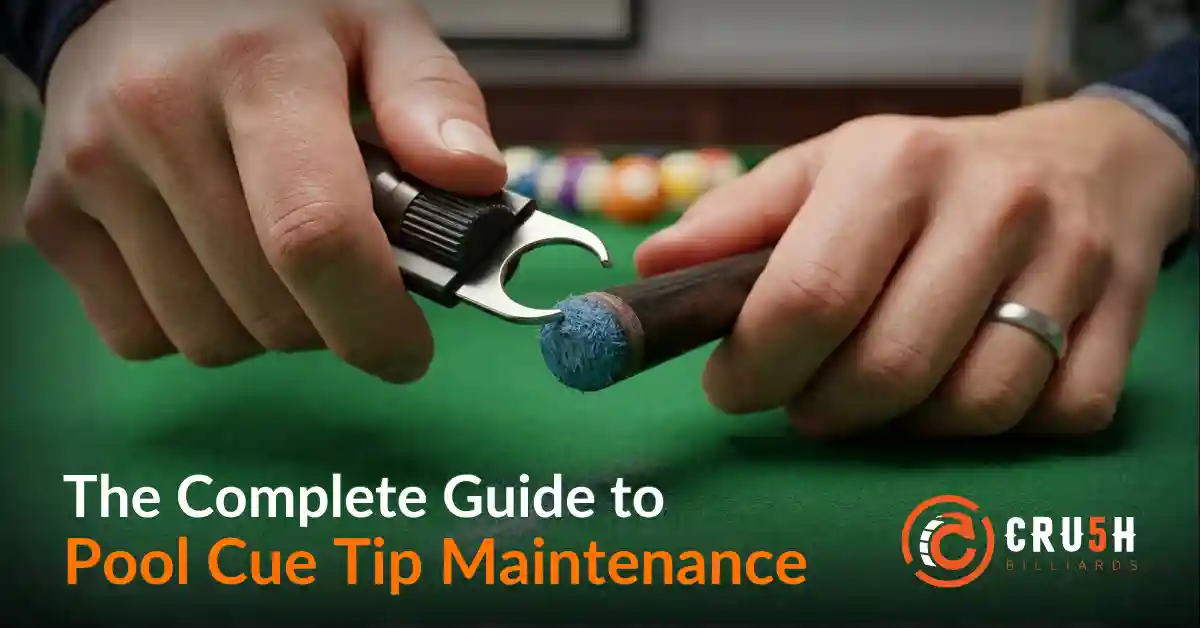
To shape your cue tip, you need a quality cue tip shaper tool. The CRU5H Billiards cue tip shaper is specifically designed for this purpose and offers a three in one design that combines shaping, scuffing, and polishing in a single, convenient tool. Using a dedicated shaper is far superior to improvised methods like sandpaper or files, because a proper shaper maintains the correct radius consistently and removes material evenly across the tip surface. This prevents the uneven shaping that can occur with flat abrasives and ensures your tip retains its intended curvature.
Begin by placing your cue in a stable position, either in a cue holder or resting securely on the table. Hold the cue tip shaper against the tip and rotate the cue slowly while applying light, even pressure. You do not need to press hard; the abrasive surface of the shaper will remove material efficiently with gentle contact. Rotate the cue two to three full turns while maintaining consistent pressure, then inspect the tip to check the shape. You are looking for a smooth, even dome with no flat spots on top. If you can see a flat area, continue shaping with a few more gentle rotations until the dome is uniform across the entire tip surface.
After shaping, it is important to remove any debris or loose fibers from the tip. You can do this by gently tapping the tip against the palm of your hand or using a soft brush to clear away the dust. Inspect the tip closely under good lighting to ensure the shape is even and symmetrical. A well shaped tip should look like a smooth, rounded dome without any irregularities or flat patches. This process should take no more than a minute or two once you are familiar with the technique, and it should be performed whenever you notice the tip starting to flatten or develop an uneven profile during regular play. For a premium cue tip shaper built for precision, visit the CRU5H Billiards cue tip shaper page at cru5hbilliards.com.
While shaping addresses the overall curvature of the tip, scuffing focuses on the surface texture. Over time, the repeated impact of striking the cue ball compresses the leather fibers on the surface of the tip, creating a smooth, glossy layer known as glazing. A glazed tip cannot hold chalk effectively because the compacted surface has no pores for the chalk to adhere to. When you apply chalk to a glazed tip, it sits on the surface as a loose powder rather than embedding into the leather, which means it will wipe away almost immediately on the next shot. This is a leading cause of miscues and inconsistent play.
Scuffing the tip restores the porous, textured surface that allows chalk to grip and hold. There are several methods for scuffing a cue tip, each with different levels of aggressiveness. The gentlest approach is to use a cue tip scuffer, which is a small tool with a rough surface designed specifically for this purpose. The CRU5H Billiards three in one cue tip shaper includes a scuffer component that makes this process simple and efficient. Simply hold the scuffer against the tip surface and rotate the cue several times with light pressure, just as you would when shaping. The scuffer will roughen the surface of the leather without removing significant material, which preserves the tip shape while restoring its ability to hold chalk.
For tips that are severely glazed or have developed a hard, shiny surface, a slightly more aggressive approach may be needed. Some players use a prick tool or needle to poke small holes in the tip surface, which creates additional texture for chalk adhesion. However, this method should be used sparingly because excessive poking can weaken the structure of the tip and shorten its lifespan. A better approach is to use a scuffer with a coarser grit and apply slightly more pressure, which removes the glazed layer without damaging the underlying leather. The goal is always to restore texture while preserving as much tip material as possible.
After scuffing, apply a fresh coat of chalk to the tip and observe how it adheres. A properly scuffed tip will hold chalk visibly and evenly across the entire surface, with no shiny spots remaining. If you notice areas where chalk does not seem to stick, those spots may need additional scuffing attention. Once the tip holds chalk uniformly, it is ready for play and you should notice an immediate improvement in the feel and consistency of your shots. As a general rule, scuff your cue tip every two to three playing sessions, or whenever you notice the chalk not gripping the tip surface as effectively as it should.
Mushrooming is one of the most common problems that pool players encounter with their cue tips. It occurs when the edges of the tip expand outward beyond the diameter of the ferrule, creating a flared or mushroom shaped profile. This happens because the repeated impact of the cue ball compresses the leather at the contact point while the edges of the tip, which receive less compression, gradually spread outward. Mushrooming is more common with soft tips and with players who use a lot of english, as side spin places additional lateral force on the tip edges during impact.
A mushroomed tip causes several problems. First, it alters the effective curvature of the tip, which changes the contact dynamics with the cue ball. The flared edges create an uneven surface that can cause unpredictable shots, particularly when applying side spin. Second, the overhanging edges are prone to catching on the cloth or the cue ball during off center hits, which can tear the tip or cause sudden, dramatic miscues. Third, a mushroomed tip looks unprofessional and indicates to other players that equipment care has been neglected, which can affect your confidence and perception at the table.
Preventing mushrooming is largely a matter of regular maintenance. By shaping your cue tip frequently and keeping the edges trimmed to match the ferrule diameter, you prevent the leather from expanding past its intended boundary. When you shape your tip with a quality cue tip shaper, pay attention to the edges and ensure they are trimmed flush with the ferrule. The CRU5H Billiards cue tip shaper is designed to maintain the correct radius while also keeping the edges contained, which addresses both shaping and mushroom prevention in a single step. If your tip has already developed significant mushrooming, you may need to use a sharper tool or a dedicated tip trimmer to remove the excess material before reshaping.
For players who experience persistent mushrooming despite regular maintenance, it may be worth considering a slightly harder tip or a tip with a different layered construction. Multi layered tips tend to resist mushrooming better than single layer tips because the individual layers distribute compression more evenly. Additionally, ensure that your stroke technique is not contributing to the problem. Striking the cue ball with extreme off center hits, especially with a closed bridge that restricts cue movement, places excessive lateral force on the tip and accelerates edge wear. A smooth, level stroke with proper follow through minimizes unnecessary stress on the tip and helps it maintain its shape longer between maintenance sessions.
Having the right tools makes pool cue tip maintenance significantly easier and more effective. While it is possible to maintain a tip with improvised tools, investing in dedicated billiards accessories designed specifically for this purpose yields better results and extends the life of your equipment. The following accessories are considered essential for any serious player who wants to keep their cue tip in top condition throughout their playing career.
A quality cue tip shaper is the single most important accessory in your maintenance kit. As discussed earlier, the CRU5H Billiards stainless steel cue tip shaper combines three functions into one compact, durable tool. It features a shaping surface for maintaining the proper tip curvature, a scuffer for restoring surface texture, and a polishing element for smoothing rough edges after shaping. The stainless steel construction ensures long lasting performance and resistance to wear, even with frequent use. This multifunctional design means you can carry a single tool instead of juggling multiple accessories, which is especially convenient for players who travel to tournaments or league nights. For more details on this essential tool, visit the CRU5H Billiards cue tip shaper product page at https://cru5hbilliards.com/product/cue-tip-shaper/.
A reliable chalk holder is another essential accessory that supports tip maintenance indirectly but significantly. Chalk that is left loose in your pocket or cue case absorbs moisture, picks up lint, and crumbles into an inconsistent powder that does not apply evenly to the tip. The CRU5H Billiards aluminum magnetic chalk holder protects your chalk from environmental damage and keeps it accessible during play. The magnetic design allows for quick, one handed access so you can chalk up between shots without breaking your rhythm. Available in round and octagon styles, this chalk holder fits popular chalk brands including Taom Pyro, Taom V10, and Predator 1080 chalk. Protecting your chalk quality directly supports your tip maintenance efforts because clean, dry chalk adheres better to a properly scuffed tip surface. Learn more about the chalk holder at https://cru5hbilliards.com/product/chalk-holder/.
A slip on moosehead bridge is an often overlooked accessory that also contributes to equipment care. When you need to use a bridge for long reach shots, using your own portable bridge instead of the house bridge prevents unnecessary wear on your cue shaft. The CRU5H Billiards slip on moosehead bridge is made from lightweight aluminum and fits any pool cue with its universal slip on design. It offers nine shot positions and a durable construction that withstands regular use. By using a personal bridge, you avoid resting your cue on abrasive surfaces or in unclean bridge heads that can damage the shaft ferrule or transfer dirt to your tip. Check out the moosehead bridge at https://cru5hbilliards.com/product/moosehead-bridge/.
The frequency of cue tip maintenance depends on several factors including how often you play, the type of tip you use, your playing style, and the conditions of the tables you play on. There is no single schedule that works perfectly for every player, but understanding the variables involved will help you develop a maintenance routine that keeps your tip in optimal condition without unnecessary wear from over maintenance.
For casual players who hit the table once or twice a week, a basic maintenance routine should include scuffing the tip before each session and a full shape check every two to three weeks. This frequency is generally sufficient to prevent glazing and maintain the tip curvature for casual play. If you notice the tip starting to feel slick or chalk not adhering well, that is a clear sign that scuffing is needed regardless of your regular schedule. Similarly, if your shots feel inconsistent or you experience occasional miscues, check the tip shape first before assuming there is a problem with your stroke mechanics.
For regular league players or those who practice several times per week, more frequent maintenance is recommended. Scuffing should be performed at the start of every session, and the tip shape should be checked and adjusted weekly. League play often involves longer sessions with more shots per visit, which accelerates wear on the tip surface. Additionally, the competitive environment of league play means that even small inconsistencies in tip condition can have noticeable effects on shot outcomes, making regular maintenance more important for consistent performance.
Professional and tournament players typically maintain their cue tips daily, sometimes even between matches during a tournament. This level of attention ensures that the tip is always in perfect condition for the highest level of competition. While most recreational players do not need this frequency of maintenance, the principle is instructive: the more important the session, the more recently the tip should be maintained. Before any important match, tournament, or money game, take a moment to inspect your tip, scuff it if needed, and ensure it holds chalk evenly. This small investment of time can make a meaningful difference in your performance when it matters most.
Even experienced players sometimes make mistakes when it comes to cue tip maintenance. Being aware of the most common errors can help you avoid practices that actually damage your tip rather than preserve it. Understanding what not to do is just as important as knowing the correct techniques, because bad habits can quietly degrade your tip over time and lead to premature replacement.
One of the most common mistakes is over shaping the tip. Some players shape their tip too aggressively or too frequently, which removes more leather than necessary and shortens the life of the tip significantly. Remember that shaping should be a gentle, incremental process. A few light rotations with a quality cue tip shaper are usually sufficient to restore the proper curvature. If you find that you need to remove a lot of material to achieve the right shape, it probably means you have waited too long between maintenance sessions. Establish a regular routine so that each shaping session only requires minimal material removal.
Another frequent error is using the wrong type of abrasive for shaping or scuffing. Sandpaper, emery boards, and files that are not specifically designed for cue tips can create an uneven surface, remove too much material, or leave scratches that affect tip performance. Dedicated cue tip tools are engineered to work with leather at the correct aggression level, providing consistent results without damaging the tip structure. Investing in a proper tool like the CRU5H Billiards three in one shaper eliminates this risk and provides better results than any improvised alternative.
Neglecting to clean the tip between maintenance sessions is another overlooked mistake. Chalk dust, cloth fibers, and debris can accumulate on the tip surface and in the porous structure of the leather, which reduces its ability to hold fresh chalk. A quick wipe with a slightly damp cloth or a light tap after each session removes loose debris and keeps the tip surface clean. Some players also use a special tip cleaner or conditioner periodically to deep clean the leather and restore its porosity. These products can be particularly useful for players who use soft tips, which tend to absorb and retain more debris over time.
Finally, failing to address ferrule damage alongside tip issues is a mistake that can lead to more serious equipment problems. The ferrule is the white or cream colored section between the tip and the shaft, and it plays an important role in protecting the shaft end and providing a clean mounting surface for the tip. If your ferrule is cracked, chipped, or developing gaps between it and the tip, moisture and debris can enter the joint between the tip and ferrule, which can weaken the glue bond and cause the tip to detach during play. When you notice ferrule damage, address it promptly by having a qualified cue repair technician replace the ferrule before it causes further problems.