
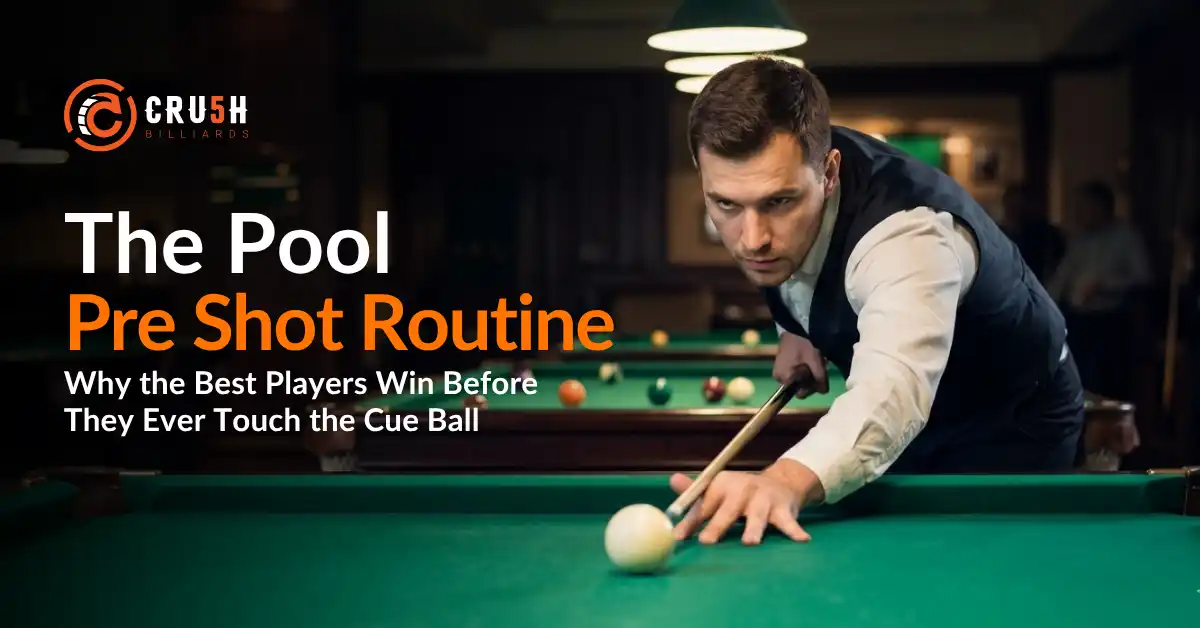
Watch a professional pool player from across a crowded room and you will notice something that has nothing to do with their stroke. Before they ever bend down over the table, before they even pick up their cue, there is a sequence of events happening. They walk to the table. They stop at a specific angle. They stand behind the shot, eyes moving between the cue ball and the object ball. They take a breath. They step into their stance in a particular way. Then they shoot.
That sequence is not accidental. It is not a nervous habit. It is one of the most deliberately trained skills in the entire game of pool, and it goes almost entirely unnoticed by players who are still trying to figure out why they miss.
It is called the pre shot routine, and it is what separates players who perform consistently from players who perform occasionally.
What Is a Pool Pre Shot Routine and Why Does It Matter?
A pool pre shot routine is a repeatable, deliberate sequence of physical and mental actions that a player performs before every single shot. Every single one. Not the hard shots. Not the shots that make you nervous. Every shot, from the opening break to the last ball on the nine, gets the exact same process.
The purpose is not ritual for its own sake. The science behind it is rooted in sports psychology and motor learning. When you repeat the same physical sequence before executing a motor skill, your nervous system interprets that sequence as a readiness signal. Your muscles relax into the familiar preparation. Your breathing settles. Your focus narrows to the task in front of you rather than the noise around you.
Elite athletes in virtually every sport use pre performance routines. Basketball players bounce the ball a set number of times before a free throw. Tennis players bounce the ball before their serve. Golfers go through a deliberate waggle and alignment process before every shot. These are not superstitions. They are proven mechanisms for delivering consistent performance under variable conditions.
Pool is no different. In fact, pool demands a pre shot routine even more than many other sports because the conditions change so dramatically from shot to shot. The angle changes. The distance changes. The required English changes. Your physical position at the table changes. Without a consistent process to walk you into each shot, your preparation becomes random, and random preparation produces random results.
The Mental Side of Pool That Most Players Never Train
Here is a truth that experienced players know and beginners discover the hard way: pool is about sixty percent mental.
You can have the most technically sound stroke in the room and still run three balls and choke when the pressure shows up. You can know exactly where the cue ball needs to go and still lose your focus in the middle of the shot. You can play brilliantly in practice alone and then miss simple shots the moment someone is watching.
This happens because technical skill and mental skill are two different things, and most players only train one of them.
Technical training improves your mechanics. You practice your stance, your bridge, your backswing length, your follow through. These are physical skills that develop over time with repetition. Mental training improves your ability to access those physical skills when it actually counts.
A pool pre shot routine is the bridge between the two. It is the mechanism that tells your body it is time to access everything you have trained, regardless of the score, the noise level, the stakes, or how the previous shot went.
Without that bridge, your mental state at the table is left entirely to chance. And chance is a terrible game plan.
Breaking Down the Perfect Pool Pre Shot Routine
There is no single pre shot routine that works identically for every player. What works for a nine ball pro competing on television may feel completely unnatural for a league player in a neighborhood hall. That said, every effective routine shares the same structural components. What changes is how each player personalizes those components.
Before you think about how to make the shot in front of you, look at the entire table. Where are the problem balls? Where is your next shot after this one? Where does the cue ball need to be after contact to give you the best path to the next three balls?
This is your strategic layer. It happens on your feet, walking around the table, seeing the full picture. Players who rush this step often make the shot they are looking at and leave themselves in terrible shape for the next one. Seeing the table in full before committing to your approach is how good players think two and three shots ahead.
Once you have read the table and chosen your shot, the decision is made. You are not second guessing mid approach. You are not thinking about alternatives while you are getting down on the ball.
This step sounds obvious but it is where a surprising number of players fall apart. They half commit to a shot, start doubting it halfway through their stance, and either try to adjust at the last second or talk themselves into hesitation at the moment of truth.
The pre shot routine demands that you commit fully before you get down. Make your decision, lock it in, and then trust it through execution.
Now you move into your physical approach. This is where the routine becomes most visible and most personal. Some players step into their stance from a specific side. Some take a practice swing before getting down. Some place their bridge hand first, then lower their body into position.
Whatever your sequence, it needs to be consistent. The goal is that your physical approach to the table becomes automatic so that your conscious mind can be fully focused on the shot itself rather than on managing your body position.
Stand behind the shot line, roughly two to three feet behind the cue ball, and confirm your aim from that angle. Look at the contact point on the object ball. Look back at the cue ball. Look at the object ball again. When you see your line clearly, begin your approach.
Your stance should feel the same every time. Feet positioned consistently. Weight is distributed the same way. Body angle at the table matching your natural setup.
One useful self check as you settle in: your grip hand should be relaxed. Not loose enough to lose control, but not squeezing. A tense grip telegraphs tension everywhere else in your body and kills your stroke fluidity. If you notice your grip is tight as you settle, that is your signal to pause, reset, and approach again.
Some players do a small chin drop or a deliberate exhale as their final signal that they are settled and ready. Find your version of this and use it consistently.
Warm up strokes, sometimes called practice strokes, serve two critical functions. They rehearse the feeling of the stroke you are about to commit to, and they give your eyes a final opportunity to confirm your line before execution.
Most experienced players take between two and four warm up strokes. During these strokes, your eyes should be moving between the cue ball and the object ball, confirming the contact point. Your stroke should be the actual pace and follow through you intend to use, not a lazy preview.
The last warm up stroke is the final confirmation. If something feels off, that is your last legitimate opportunity to stand back up, reset, and approach again. Once your final warm up stroke is complete and you commit to the shot, you shoot.
Your eyes should finish on the object ball at the moment of contact. Not on the cue ball. Not on the pocket. On the exact contact point on the object ball.
This is one of the most commonly violated fundamentals in pool, even among experienced players. The instinct is to watch the cue ball as you strike it, especially on shots where you are applying english. But your cue and your bridge hand manage cue ball contact without your eyes needing to supervise. The object ball is what you need to be looking at in the final moment.
Building Your Routine: How to Actually Train It
Reading about a pre shot routine and building one are two completely different things. Here is how to actually develop yours so that it becomes automatic rather than forced.
In your next practice session, consciously walk through each step of the routine on every shot. Do not rush. Do not skip steps because you think a shot is easy. Easy shots are where the habit is built, because when the pressure is on and a shot is not easy, your routine needs to be deeply automatic.
It will feel slow at first. It will feel like you are overthinking. That awkwardness is the routine becoming a habit. Push through it.
After each practice session, write down two or three things about how your routine felt. Where did you rush? Where did you second guess your commitment? Where did you notice tension in your grip? A shot journal makes invisible patterns visible so you can address specific weaknesses rather than hoping things improve generally.
Play a casual game and impose a rule on yourself: if you skip any part of your routine, you forfeit that shot. No exceptions. This is not about perfectionism. It is about forcing yourself to value the process the same way regardless of the apparent difficulty of the shot. Eventually, the routine runs itself without conscious management.
A phone propped at the end of the table gives you priceless feedback about your actual routine versus what you think your routine is. Most players are shocked to discover how much variation exists between shots. Watching yourself reveals where your physical approach drifts, where your warm up strokes get rushed, and where your eyes are going during the shot.
What Happens Under Pressure
Here is the real test of a pre shot routine: the moment when the game is on the line.
You need one ball to win the match. Your opponent has been talking. There are people watching. Your hands want to shake. Your mind is flooding with awareness of the moment.
This is precisely when your routine does its most important work.
When everything else in your environment is different from your practice sessions, the routine is the one thing that is exactly the same. Walking through those familiar steps sends your nervous system back into a state it recognizes. Your body knows this sequence. It has done this sequence a thousand times. The physical and mental familiarity of the routine overrides the noise of the moment and brings you back to the only place that matters: this shot, right now.
Players who have no routine have nothing to return to when pressure shows up. Their pre shot process varies from shot to shot in practice, so under pressure they have no anchor. They become a passenger in their own game, hoping the pressure passes before they miss.
Players with a locked in routine have somewhere to go. When nerves arrive, they step into the process they trust. The routine becomes calm inside the storm.
The Role Your Gear Plays in Your Routine
This might seem like an odd place to talk about equipment, but the physical tools you use at the table are part of your routine whether you think about them that way or not.
Chalking up is a part of many players’ pre shot routine, a consistent chalk application before getting into your stance is both a practical step and a mental preparation signal. The same applies to straightening your glove on your bridge hand, checking your tip, or clicking your chalk holder back to the rail. These small physical actions are cues, in the psychological sense of the word, that signal to your brain that preparation is happening.
When your gear is reliable, when your chalk holder is within reach, when your cue glove sits properly, when your tip is in good shape, your routine flows without interruption. When gear fails mid routine, the disruption breaks your mental preparation and forces you to restart.
This is one of the reasons serious players invest in quality accessories. The gear should disappear into the background of your routine, not interrupt it.
A Final Word on Consistency as a Skill
Pool players spend enormous amounts of time working on spin, on pattern play, on break technique, on kick shots and banks and combinations. All of that is worth developing. But consistency, the ability to show up at the same level shot after shot, session after session, match after match, is perhaps the most valuable skill in the game, and it is the one that gets the least deliberate attention.
Your pool pre shot routine is the engine of that consistency. It does not make hard shots easy. It does not guarantee you pocket everything. What it does is give you the best possible version of yourself on every single shot, regardless of what just happened and regardless of what is coming next.
Build your routine. Train it until it runs itself. Trust it when the pressure shows up.
Then watch what happens to your game.