
Something quiet but significant has been happening at pool tables across the country. Players who once grabbed whatever tip came installed on their cue, or whatever the shop had in stock, are now doing serious research before they commit to a pool cue tip. They are reading reviews, testing different hardness levels, and making deliberate choices based on how they actually play. The era of the throwaway tip is fading, and in its place is a much more thoughtful conversation about what actually sits at the end of your cue and why it matters as much as any other piece of equipment you own.
If you have spent time around serious pool players recently, you may have heard the same brands come up over and over. Kamui. Predator Victory. Thoroughbred. Moori. Taom. These are not just brand names being dropped casually. They represent a generational shift in how players think about their pool cue tip, and understanding what is driving that shift is the key to making the right choice for your own game in 2025.
This guide is the most complete resource you will find for navigating that decision. Whether you are replacing a worn tip for the first time or upgrading from something generic to something purpose built for your playing style, everything you need to know is right here.
Let us start with a simple truth that too many players overlook for too long. Your pool cue tip is the only part of your entire cue that ever makes contact with the cue ball. Everything else, the shaft, the joint, the wrap, the butt, all of it feeds into the stroke. But the tip is where the stroke becomes a shot.
That means every decision about how much spin to apply, how fast the cue ball travels, whether you draw it back or push it forward, flows through that small disc of leather at the end of your stick. The quality of your tip determines how reliably and consistently those intentions translate into outcomes on the table. A degraded, poorly shaped, or mismatched tip turns good mechanics into unpredictable results. A quality, well maintained tip that fits your game style turns your intentions into execution almost automatically.
This is why serious players are switching. They have stopped treating the tip as an afterthought and started treating it as a precision component, because that is exactly what it is.
For years, the default behavior was simple. A tip came on the cue from the factory or from a shop, you played with it until it fell off or flattened out, and then you asked for a replacement without much thought. In a recreational setting where the goal is just to have fun, this approach works fine. But as players develop and start caring about consistency and improvement, the limitations of that approach become very clear very fast.
Stock tips on affordable cues are almost always single layer leather cut from a single piece of hide. These tips wear unevenly, compress quickly, mushroom over the ferrule edge, and lose their shape between sessions. That inconsistency becomes a real problem the moment a player starts working on specific skills. You cannot build reliable muscle memory around a tip that behaves differently every session.
The second reason players are switching is the rise of carbon fiber shafts. As brands like Predator, Cuetec, and Mezz pushed carbon fiber technology into the mainstream, a new performance problem emerged. Carbon fiber shafts have minimal deflection and deliver energy much more efficiently than traditional maple shafts. That precision exposed a weakness in conventional tips. A soft single layer tip that might feel fine on a maple shaft becomes inconsistent and unpredictable on a carbon fiber shaft because it cannot handle the energy transfer reliably.
Tip makers responded to this challenge. The Kamui Athlete series, for example, was designed specifically to complement carbon fiber shafts by layering leathers of different hardness together to create a tip with both structural rigidity and responsive elasticity. That kind of engineering does not happen in a budget tip, and players who invested in carbon fiber shafts quickly learned that upgrading to a compatible tip was not optional if they wanted to get the performance they paid for.
To understand how your tip selection fits into the bigger picture of your equipment setup, our complete pool cue buying guide breaks down every component from ferrule to butt and explains how each one affects the overall playing experience.
Before you start comparing brands, you need to understand the four variables that every tip decision comes down to. These are hardness, construction, material, and size. Once you have clarity on each of these, choosing the right tip becomes straightforward.
Tip hardness controls how the leather compresses at the moment of contact with the cue ball, and that compression determines everything about how the shot behaves.
A soft tip compresses more deeply, creating longer contact time between the tip and cue ball. That extended dwell time is what allows a player to impart spin, draw, follow, or English with less physical effort. Soft tips are the choice of spin oriented players, advanced players who rely heavily on cue ball position work, and anyone playing on newer cloth where the balls respond quickly. The trade off is that soft tips mushroom faster, require more frequent shaping, and need closer attention between sessions. Brands like Kamui Super Soft and Predator Victory Soft live in this category.
A medium tip sits in the sweet spot that the majority of players, from intermediate recreational players to competitive league players, find most reliable. It provides enough compression for spin work without the maintenance demands of a soft tip, and enough firmness to support power shots without the rigidity of a hard tip. Tiger Everest Medium and Predator Victory Medium are the most commonly recommended options in this range, and for good reason. They perform consistently across a wide range of shot types and skill levels.
A hard tip delivers a faster, firmer hit that transfers energy to the cue ball with minimal compression. The result is a quick, responsive shot that suits power oriented players. Hard tips also last significantly longer and require almost no shaping maintenance. The trade off is reduced spin control, especially on off center hits. For players who play a straight, aggressive, position first game, a hard tip is a perfectly valid choice.
Phenolic tips are in a class entirely their own and are used almost exclusively on break cues. They are as hard as the balls themselves and are built to withstand the repeated shock of full power break shots without degrading. They require almost no maintenance, transfer maximum power, and have no ability to generate spin. Many leagues and tournaments restrict phenolic tips on playing cues, so always confirm your competitive ruleset before installing one.
Single layer tips are cut from a single piece of leather. They are affordable and accessible and cover the needs of casual players perfectly. The limitation is consistency. A single piece of leather has natural variation in density, and as it compresses with use, that variation creates unpredictable performance changes over time.
Layered tips are built from multiple sheets of pressed leather, ranging from 6 layers in entry level premium tips to 10 layers in flagship products like Kamui Black and Moori. The layering process creates a far more uniform structure that maintains consistent density from the outer surface all the way to the base. That consistency is what makes layered tips the standard for competitive and serious recreational players. The tip behaves the same way in the hundredth session as it did in the first, which is essential for building repeatable technique.
The Kamui Clear series adds another layer of innovation. The base layer of these tips is engineered to resist glue absorption during installation, which keeps the structural integrity of the tip intact from day one and prevents the hardening that typically occurs in tips where glue has migrated upward through the layers over time.
Leather is the universal standard for playing cue tips, and specifically pigskin leather, which offers the ideal combination of porosity for chalk retention and structural density for consistent compression. Japanese pigskin, used by Kamui, Moori, and several other premium brands, is considered the highest quality source material currently available in the tip market.
Alternatives exist for specific use cases. Phenolic resin is the standard for break tips as mentioned above. Some newer composite constructions blend leather with synthetic materials to achieve specific performance profiles, though these remain a niche category compared to pure leather options.
The key quality indicator in leather tip construction is the tanning process. Moisture resistant tanning, as used in Kamui Black tips, keeps the leather from absorbing humidity from the playing environment, which would otherwise cause inconsistent compression behavior depending on the conditions of the room you are playing in. This is a small detail that matters enormously over the course of a long session or a multi day tournament.
Most playing cues use a 13mm tip diameter, which has become the near universal standard in the American pool market. Some shafts are trimmed slightly to 12.75mm or 12.5mm to create a smaller contact patch for increased precision on off center hits. Snooker cues use much smaller tips in the 9mm to 10mm range for the extreme precision that game demands.
The practical guidance here is simple: your tip should match your shaft diameter as closely as possible, and the tip should be trimmed and shaped to fit after installation. Buying oversized tips and trimming them yourself is common among experienced players, as it gives you control over the final fit. If you are having your tip installed by a shop, they will handle this step for you.
For a deeper breakdown of how tip size relates to your overall cue specs, our pool cue tip maintenance and care guide covers sizing, shaping, and everything else that keeps your tip performing at its best session after session.
With the fundamentals clear, here is a focused look at the brands that are genuinely worth your attention and your money right now.
Kamui remains the benchmark against which every other layered tip is measured. Their Clear Black series uses 10 layers of moisture resistant Japanese pigskin leather that maintain porosity and elasticity throughout the tip’s lifespan. The hardness range covers Super Soft, Soft, Medium, and Hard options, giving players at every level and style a version that fits their game. The Kamui Athlete series, introduced to specifically address carbon fiber shaft compatibility, layers leathers of different densities together to create a tip with hybrid performance characteristics. For players who want the best and are willing to maintain it properly, Kamui is the top choice in the market.
Predator Victory tips are the choice of players who want professional level performance without the ultra premium price of Kamui. Built from 8 layers of leather and tested with professional players during development, these tips hold their curve exceptionally well over time, which is one of the most common failure points in competing products. The high contrast yellow color is a practical design touch that helps players see their contact point and tip shape clearly even in dim pool hall lighting.
Moori is the tip of choice for players who want the absolute best and are willing to pay for it. Handcrafted in Japan with a meticulous attention to detail that has earned endorsements from world champions across multiple disciplines, Moori tips offer a level of consistency and refinement that competitive players at the highest level depend on. Each tip is factory sealed in a bubble pack to arrive in perfect condition without any pre installation drying or hardening.
Tiger Everest is the most universally recommended tip for developing players and league level competitors who want reliable, low maintenance performance. It is not the most technical tip on the market, but it performs consistently, holds chalk well, and does not demand the level of maintenance that softer layered tips require. For someone building their game and wanting their equipment to stay out of the way while they focus on technique, Tiger Everest is a genuinely excellent choice.
Thoroughbred Tips have earned a dedicated following among players who prioritize spin and cue ball control. Made from dark brown Japanese pigskin in 6 and 8 layer constructions, these tips are known for responding to even gentle off center contact with impressive spin output. They resist glazing effectively, which means chalk retention stays consistent across their entire lifespan rather than degrading as the surface polishes over time.
Taom Pro Tips have grown rapidly in competitive circles, particularly among carbon fiber shaft users. Coming from the same Finnish brand that created the widely praised Taom chalk, these tips are built around the same philosophy of reducing friction inconsistency and improving overall cue ball control. They pair naturally with Taom chalk, and players who use both together report a noticeable improvement in how predictably the cue ball responds to spin applications.
Choosing the right tip is not about copying what a professional uses. It is about honest self assessment of how you currently play and what you are working to improve.
If your game centers on cue ball control, position play, and applying English with precision, a soft or medium soft layered tip will give you the most feedback and the most responsive feel for spin work. Kamui Soft, Thoroughbred, or Predator Victory Soft are the natural fits here.
If you play a more direct game that prioritizes accuracy and speed over spin, a medium or medium hard tip will match your style without demanding the maintenance that softer options require. Tiger Everest Medium or Predator Victory Medium are the go to recommendations.
If you are newer to the game and still developing your style, start with a medium tip and stay there until you have enough experience at the table to know what you want to change about your cue ball behavior. Trying to play with an ultra soft tip before you have clean, consistent contact mechanics is like driving a race car before you have learned to drive. The tool is capable, but you are not ready to use what it offers.
If you play competitively and have invested in a carbon fiber shaft, make sure your tip is compatible. Kamui Athlete, Predator Victory, and Taom Pro are all engineered with carbon fiber shaft users in mind and will complement that investment rather than undermine it.
For our full recommendations on how to pair your tip with the right shaft and complete cue setup for your skill level, visit our pool cue setup guide for every level of player where our team breaks down exactly what works at each stage of the game.
Choosing the right tip is only half the story. The other half is keeping it in good condition so it performs the same way in month six as it did on day one.
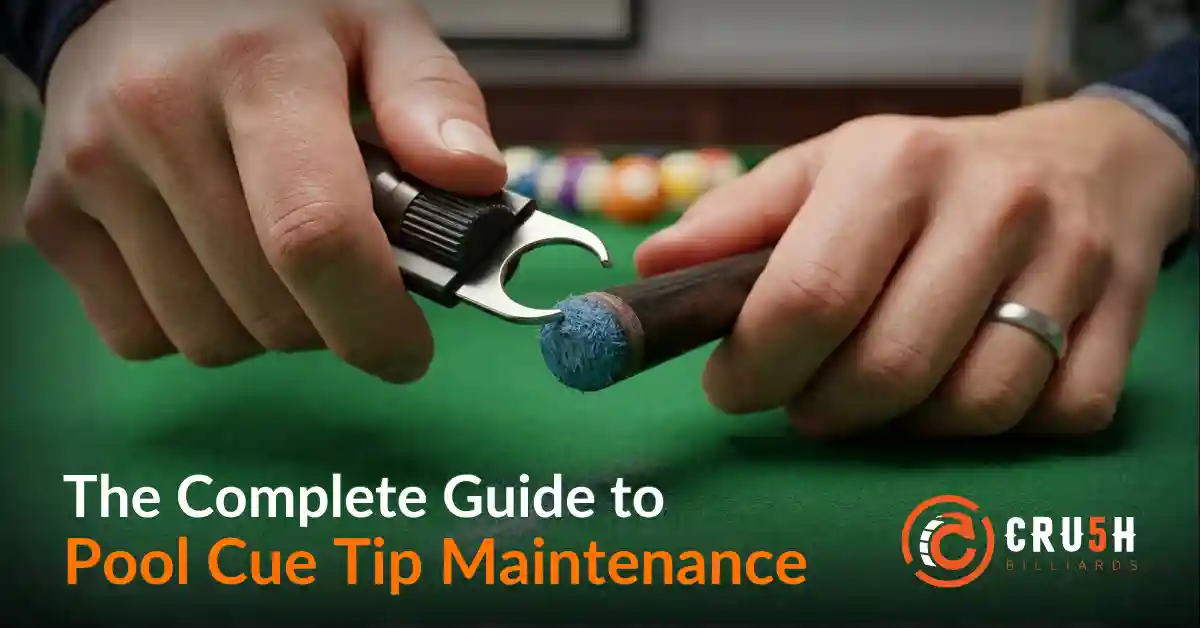
Shape your tip regularly. The most common maintenance failure among recreational players is letting their tip flatten out before shaping it. A flat tip loses accuracy on off center shots because the contact patch with the cue ball becomes too large and unpredictable. Use a tip tool to maintain a nickel or dime radius curve and check the shape every few sessions.
Chalk before every shot. This is not just a pre shot ritual. Chalk fills the microscopic gaps in the leather surface that prevent slipping contact between the tip and the cue ball. A well chalked tip transmits spin reliably. An under chalked tip miscues unpredictably. One or two light taps of chalk before every shot is the standard, and it protects both your tip and your shot.
Scuff the surface periodically. Soft leather tips can glaze over with extended use, becoming smooth and reducing their chalk holding ability. A tip pick or scuffer opens the surface back up so chalk grips properly. This is a 30 second task that dramatically extends the functional life of any layered tip.
Replace at the right time. Even the best pool cue tip has a lifespan. Most quality layered tips last 6 to 12 months under regular play. Signs that it is time for a replacement include mushrooming over the ferrule edge, persistent miscues even after chalking, a glazed surface that scuffing cannot restore, and visible cracking or separation at the layers. Replacing the tip proactively, before it fails completely, keeps your game consistent rather than forcing you to adjust mid season.
The shift happening in billiards right now is not complicated. Players who care about improving are realizing that the pool cue tip deserves the same deliberate attention they give to their shaft, their technique, and their practice routine. A $20 to $30 investment in a quality layered tip delivers more direct performance improvement per dollar than almost any other equipment upgrade available.
Know your playing style. Choose a hardness and construction that matches it. Buy from a brand with a proven record of consistency. Maintain what you have with regular shaping and chalking. Replace when it is time.
Those four steps are what separates the players who struggle with their equipment from the players who trust it completely and focus all of their energy on the game.
At Crush Billiards, we carry the full range of premium pool cue tips including Kamui, Predator Victory, Tiger, Thoroughbred, Taom, and more. Our team plays the game and knows what works, and we are happy to help you find the exact tip for your specific setup and style. Visit us at cru5hbilliards.com and get your game where it deserves to be.